Frameless Shower Partition 4×7 ft Hinged 2.5 ft Door · 10mm · Frameless
Hinged 2.5 ft door + 1.5 ft fixed · 10mm clear toughened · Straight
₹17,677
Before GST · Live rate
Shower glass thickness is not a style flex — it is structural and safety logic expressed in millimetres. Pick wrong, and you either overspend or under-support a door leaf that moves daily.
This guide stays practical: what builders usually specify, when thinner glass appears, and how thickness talks to glass shower partition price.
See how size and door type move totals; confirm final glass spec on site.
10mm Clear Toughened Glass + Professional Installation
Hinged: Hinges, Handle, Knob, Magnetic Seal, Silicone, L-Connector
Sliding: Top Track, Round Knob Handle, D-Seal, Bottom Guide
Seals: T, F, Magnetic, D-type (Black/Clear) – No Extra Cost
WoodenMax packages
Live calculator rates · Update when supplier rates change.
Hinged 2.5 ft door + 1.5 ft fixed · 10mm clear toughened · Straight
₹17,677
Before GST · Live rate
Sliding half–half (2 + 2 ft) · 10mm clear toughened · Straight
₹22,374
Before GST · Live rate
Hinged 2.5 ft door + 2.5 ft fixed · 10mm clear toughened · Straight
₹20,796
Before GST · Live rate
Sliding half–half (2.5 + 2.5 ft) · 10mm clear toughened · Straight
₹26,378
Before GST · Live rate
Hinged 2.5 ft door + 3.5 ft fixed · 10mm clear toughened · Straight
₹23,914
Before GST · Live rate
Sliding half–half (3 + 3 ft) · 10mm clear toughened · Straight
₹30,382
Before GST · Live rate
Hinged 2.5 ft door + 4.5 ft fixed · 10mm clear toughened · Straight
₹27,033
Before GST · Live rate
Sliding half–half (3.5 + 3.5 ft) · 10mm clear toughened · Straight
₹34,386
Before GST · Live rate

Thicker glass weighs more, bends less under spray impact, and usually demands stronger hinges or rollers. It also changes how a door feels when you open it — heavier, more solid — which many users read as “premium” even before they know the mm number.
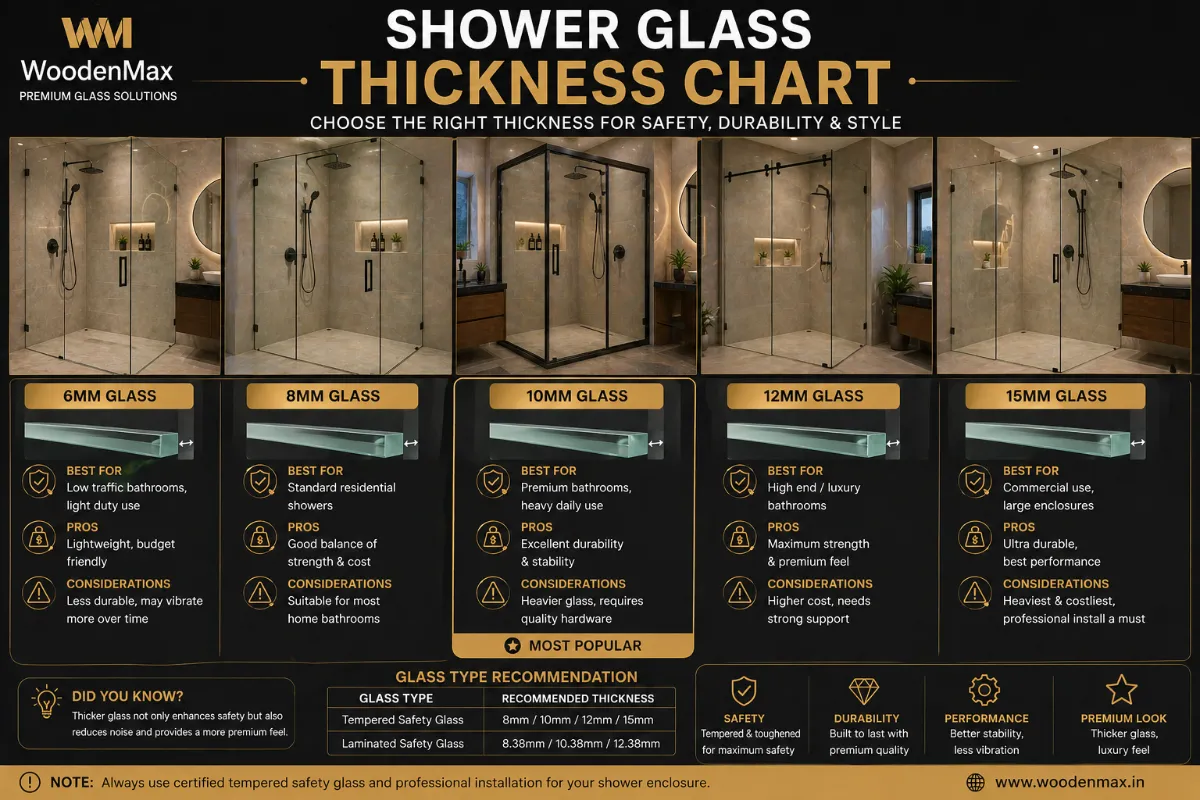
May appear in small, well-supported fixed panels. It is rarely the default for large door leaves; always follow supplier engineering for your opening.
A common residential sweet spot — balance of cost, availability, and strength for many partitions and moderate door sizes.
Frequent on larger frameless-style doors and tall panels where stiffness matters — often paired with premium fittings. See frameless glass shower price for pricing context.
Framed channels sometimes support glass differently than point-mounted frameless hardware — do not assume you can swap thickness without revisiting hinges or clamps. Compare system thinking on framed vs frameless shower.
Material cost rises with thickness, but the total job may rise faster if hardware must step up too. When budgeting, read shower installation cost alongside glass quotes — heavy panels are slower to set safely.
Frosted or textured surfaces change cleaning and privacy — cross-check shower glass types once thickness is short-listed.
Let opening size, door type, and hardware class drive thickness — not a generic meme. Bring photos and dimensions to vendors; ask them to justify their mm choice in writing.
Use this table to shortlist a direction, then run the calculator above for your exact sizes.
| Solution | Best when | ₹/sqft hint | Article |
|---|---|---|---|
| Glass partition (hinged / fixed run) | Standard wet zone, need door swing or fixed screen | Wide band — check calc | Partition price |
| Sliding shower door | Tight clearances, long openings | Often project quotes ₹12k–45k | Sliding price |
| Corner / enclosure | Splash control priority | Area + hardware | Enclosure price |
| Walk-in partial glass | Minimal door, good drainage | Panel-heavy | Walk-in |
| Frameless minimal metal | Premium look, easier wipe-down | Higher fittings | Frameless price |
Related decisions: Curtain vs glass · Framed vs frameless · Thickness · Glass types
Often yes for moderate sizes — confirm with your supplier for your exact width and height.
Commonly for larger doors, tall panels, or frameless-style hardware packages requiring extra stiffness.
It can feel more solid; acoustic gains are usually minor compared to structural gains.
Only if engineering still supports the span — never unilaterally without vendor sign-off.
Not directly — finish and water chemistry matter more for spots.
Glass shower partition price ties thickness into full quotes.